

Aerospace components are developed and designed using the best technology, ensuring they meet the highest standard. Designing aerospace-engineered components requires precision to meet the demands of the industry.
For instance, aircraft components have to perform under pressure; hence, there is no room for error in their functioning. These components should be strong and must not fracture under stress when working.

Here, CNC machining can be a reliable method to produce such significant parts. CNC machines ensure precision, material quality, and accuracy. With CNC machining, quick and accurate production is possible for aerospace essential parts.
In this article, we’ll discuss CNC-machine aerospace components, materials used, and why they’re important in detail.
What is Aerospace CNC Machining?

CNC machining uses a subtractive manufacturing technique where the material is removed as per the design. The machine has certain software and codes to conduct specific functions.
These functions control the tools and raw materials. The raw materials include metals, alloys, and high-density plastic.
The automated functions cut the materials and add finishing touches with the least human intervention. After the computer program has executed all the codes and functions, the final product is precise and strong.
These components may include aircraft hinges, clamps, and custom-size components.
A component with the same measurements can be made by CNC machining. These parts are fashioned in such a way as to ensure smooth functioning without hiccups.
What are the Benefits of CNC Machining for Aerospace Parts?

CNC machining has several advantages when used for making aerospace parts, which include:
1. Enhanced Performance
Aircraft parts have to work under pressure, so there’s no margin for faults. CNC machines make aircraft components precise and strong.
As a result, the assembled parts perform excellently in the air. Moreover, CNC machining can mold difficult metals such as titanium, which is an essential aircraft material.
2. Lightweight Parts
CNC machining can result in small and thin components, which has an upside in making the aircraft light in weight. Despite the thin frame, these components are still strong.
3. High Efficiency
The aerospace industry uses some of the most intricate designs to make complex parts. CNC machines are capable of making these parts without any faults.
Overall, automated tools result in efficient and reliable components.
4. Affordability
After the primary setup, CNC machining is cost-efficient when multiple parts are made simultaneously. Moreover, the wastage of material is less in CNC machining, and there are little to no components that will be discarded due to faults.
It makes the whole process more profitable.
5. Precision Machining
Computerized manufacturing offers precisely made parts that fit together without any spaces or constrictions. It is a significant feature of high-quality and reliable parts expected to be used in the aerospace industry.
6. Minimal Failure
Metallic parts made using traditional methods may have precision errors due to manually operated tools. It can be a cause of parts failure and impacting the working of an aircraft altogether.
CNC machining automates each process by strictly following design and size guidelines. The parts made this way are more up to the standard and do not fail in performance.
How is CNC Machining Carried Out for Aerospace Components?

A precise CNC milling machine is used to produce several aerospace components. The complex geometrical parts of aircraft and rockets have intricate shapes;
hence, they can be manufactured only on precise multi-axis CNC machines.
Using these machines reduces the manufacturing time and errors that may occur in single-operation machines. The goal is to ensure highly functional, precise parts.
Furthermore, a precision CNC turning machine is used to shape the raw metal or plastic material. This subtractive method can be useful in making cylindrical shapes such as fasteners, shafts, and connector hinges and clamps.
5 Axis CNC Machining
As we know, aircraft parts are complex and require the utmost precision. Using a 5-axis CNC machine is the solution here. These machines allow the tools to move in five directions simultaneously for precise manufacturing.
The directions include X-axis, Y-axis, Z-axis, and A and B-axis for forward and backward motion.
Moving the machining part in all these directions at the same time removes the need for extra setup to turn around. It is a highly efficient manufacturing process that is easy to maneuver.
Moreover, several complex parts can be machines in no time, even when they have different specifications. A 3- or 4-axis CNC machine can be used for less complex parts.
What are Common Materials Used in Aerospace CNC Machining?
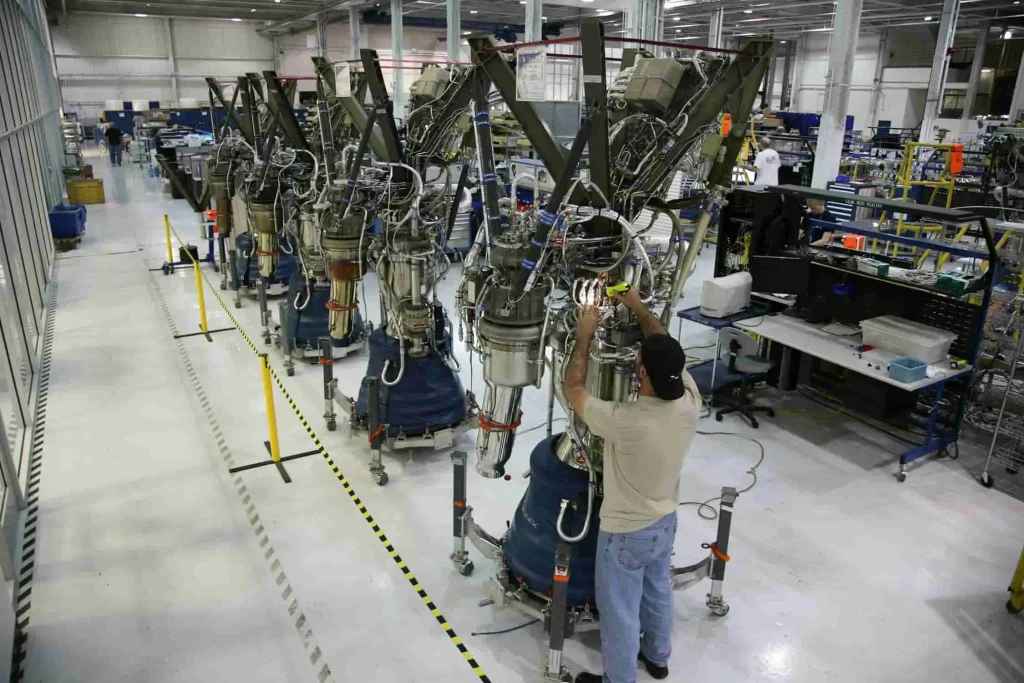
An aircraft may weigh between 1,500 pounds to over 800,0000 pounds. The weight of the raw material in aerospace parts and their size can impact the full load.
Lightweight and strong materials are preferred in aerospace CNC machining as they have to be strong enough to fly but less bulky. Aluminum, titanium, high-density plastic, and metal alloys are useful in the aerospace industry.
Aluminum is preferred for its highly malleable properties, as it can be cast into thin sheets. Titanium and its alloys are resilient.
This naturally occurring metal is known to be 50 times lighter and 30 times stronger than steel.
1. Aluminum
Aluminum is commonly used in manufacturing aerospace parts. It has tensile strength and is lightweight. Its highly formable nature makes CNC machining easier and quicker.
Aluminum alloys are used in the aerospace industry to add more desirable properties to it.
For instance, 7075 alloy contains zinc, which adds more fatigue strength. It is suitable for wings, fins, and supporting fuselage structures.
Aluminum alloy with copper is used for its machinability and strength. Aircraft’s wings and fuselage structure are machined using this alloy.
When magnesium and silicon are added to aluminum, the alloy becomes corrosion-resistant and has better formability.
2. Titanium
Titanium and its alloys are used in aerospace components as they are lightweight and strong. The naturally occurring metal is corrosion-resistant and has a high strength-to-weight ratio, implying lesser material can offer more strength.
Some prime examples of titanium-based crafts are the F-22, Boeing B787, and UH-60. The material is predominantly used in blades, shafts, discs, and airframes.
Titanium can be machined at a lower RPM for the best results, as it may lead to tool deterioration due to its high strength. However, it is worth the extra effort due to its various properties.
3. High-Density Plastics
The interiors of an aircraft are a blend of metal and polymer-based to make it functional. Since polymers are light in weight, they reduce the overall bulk of the aircraft.
The aircraft doors, wall panels, wiring conduits, and bearings are made using high-performing plastic.
Plastics such as PTFE polycarbonate, Ultem, and PEEK are used in the CNC machining of complex aerospace parts. These materials are also used for armrests, instrument panels, valves, cabin trays, and tables.
Due to strong buildup and less fracturing under stress, high-density plastics are better compared to other plastics.
Surface Finishing for CNC Machined Aircraft Parts

Aircraft parts must have surface treatments to make them more durable during their use.
1. Powder Coating
Powder coating makes the CNC machined parts resistant to scratches and losing color. The non-abrasive PTFE powder coating makes the metal or plastic more aesthetically pleasing.
It comes in various colors and is resistant to high temperatures up to 600°F.
2. Polishing
A buffing tool is used to polish the aircraft’s surface to make it smoother. Highly abrasive parts are buffed, leaving a shiny and smooth surface behind.
Polishing makes the appearance of the material better while also avoiding chipping on the surface. A polished metal is also more durable than an unpolished one.
3. Anodizing
An electrolyte solution is used to form an oxide layer over the metal. These layers prevent the metal from corrosion and abrasion under high stress and temperature changes.
A mix of phosphoric acid and boric sulfuric acid may be used to anodize aerospace parts.
Type II and Type III anodizing is done for aerospace parts. Type II is used to make the surface more aesthetically pleasing.
Another type III layer is added to make the material more durable to various environmental elements. Besides, chromic acid anodizing (CAA) is used to treat high-strength aluminum alloys.
4. Passivation
Passivation makes the metal non-corrosive and adds shine to it. A chemical solution such as nitric and citric acid is used to remove free ions and roughness from the material.
The acidic bath creates a protective oxide layer over the metal, preserving the surface from high temperatures for longer. Generally, galvanization, blueing, and immersion methods are used for the passivation process.
Applications of Aerospace CNC Machining

CNC machining is essential in the aerospace industry, offering the precision required to produce critical components. Aircraft and spacecraft consist of millions of parts, many of which must meet exact specifications for safety and performance.
Here’s how CNC machining is applied in aerospace:
1. Complex Aircraft Components
CNC machining is crucial for manufacturing complex parts such as hydraulic manifolds, fuel bodies, and landing gear. These components must be made with high precision to meet the aerospace industry’s strict safety and performance standards.
Using 5-axis CNC machining, these parts can be milled and drilled along multiple axes simultaneously, ensuring both accuracy and efficiency.
2. Lightweight Structural Parts
In aerospace, reducing weight while maintaining strength is vital. CNC machining enables the creation of lightweight parts with complex shapes, helping to lower the overall weight of aircraft and improve fuel efficiency.
Metals like titanium and aluminum are often used for these components, as they provide a strong yet light solution.
3. Interior and Functional Components
CNC machining is also used to produce interior parts like panels, ducts, and connectors. These components are often made from high-performance plastics, which are both lightweight and durable.
These materials meet fire retardant and safety regulations, making them ideal for parts that need to be strong without adding unnecessary weight.
4. Research and Development
CNC machining plays a key role in aerospace R&D, allowing for rapid prototyping of new designs. This process lets engineers quickly test and refine components before moving to full-scale production.
This capability is essential for innovation, as it speeds up the development cycle and helps bring new technologies to market more quickly.
Conclusion:
Aerospace CNC machining is critical when manufacturing fighter jets, cargo planes, spacecraft or passenger planes. Each part is made carefully according to the precise measurements.
The CNC manufacturing process is cost-saving and efficient. It enhances the crafts’ safety in the air. When machining aircraft parts, special attention should be paid to using the right size and scale of tools.
One way to avoid mistakes is to run a simulation using CNC software. It will help avoid any mistakes and make changes in the machining if needed before bulk production.
Partnering with HiTop Industrial mold designing and CNC professionals will ensure precise, high-quality parts.
Related Articles
- Medical Injection Molding: Precision in Healthcare
- Liquid Silicone Rubber Injection Molding: A Detailed Guide
- Mastering Injection Molding Tolerances: Key Insights
- Reaction Injection Molding: Process, Benefits and Uses
- Injection Molding Defects and Their Solutions
- Aluminum Injection Molding: Cost, Benefits, and Design
- ABS Injection Molding: Key Benefits, Process
- Ultimate Guide to HDPE Injection Molding
- 10 Common Plastic Resins for Injection Molding
- Injection Molding vs. Compression Molding


 English
 Arabic
 German
 Spanish
 French
 Italian
 Javanese
 Korean
 Portuguese
 Russian
 Hindi
 Chinese
