


Injecting molten plastic into a mold cavity is known as injection molding. It then cools and settles into a component or good. Wall thickness is a key factor in injection molding quality and performance.
Manufacture efficiency, dimensional stability, and structural integrity depend on wall thickness. This article discusses injection molding wall thickness estimation and management best practices.
Get into the details to work your best on your next project.
Understanding the Term: Wall Thickness in Injection Molding
In injection molding, the wall thickness is the distance between the inner and exterior surfaces. This is a fundamental value that influences many facets of the operation and the final result.
Uniform material flow, effective cooling, and defect minimization all depend on a uniform wall thickness all around the component.
The influence of wall thickness on material flow and cooling is crucial. Though they have shorter cycle durations and cool faster, thinner walls might be more likely to deform or show sink marks.
Longer cooling periods, higher material use, and possible problems with residual strains and internal cavities will all apply to thicker walls.
Guidelines for Best Injection Molding Wall Thickness
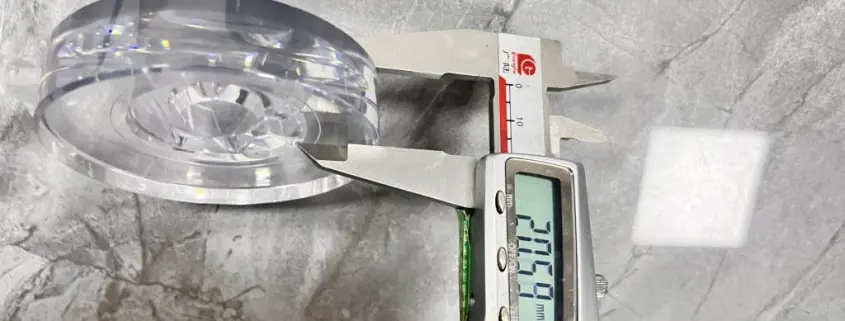
These are a starting point for designing parts and selecting materials for making wall thicknesses of anything.
a. Lowest Measure for Thickness of Walls
This wall thickness depends on the material and is usually 0.3–0.5 mm. This depends on part function, material qualities, and production needs.
For structural integrity, sections that need great strength or stiffness have a significantly larger minimum wall thickness.
b. Highest Wall Thickness
The ideal injection molding wall thickness depends on material type, component design, and mold cooling. Usually, the maximum wall thickness should be maintained to prevent extended cooling periods, sink marks, and warping.
Whereas the maximum wall thickness for the majority of thermoplastic materials is between 3 and 4 millimeters, this might vary based on the material and the design of the part.
Change of Material Depending On Wall Thickness
The wall thickness of an injection-molded product is significantly influenced by the material that is used. Different materials have different properties, such as viscosity, shrinkage rate, and thermal conductivity, that affect material flow and cooling.
Common thermoplastic materials used in injection molding are ABS (Acrylonitrile Butadiene Styrene), Nylon, Polycarbonate, Polypropylene, and Polyethylene.
Each material has its own recommended wall thickness range based on its properties and application. High-viscosity materials like glass-filled nylon need larger walls to fill the mold cavity.
Meanwhile, materials with higher thermal conductivity, such as aluminum-filled thermoplastics, may allow for thinner walls due to faster cooling rates.
Common Thermoplastic Materials Used in Injection Molding
| Material | Full Name | Density (g/cm³) | Tensile Strength (MPa) | Impact Strength (kJ/m²) | Common Applications |
| ABS | Acrylonitrile Butadiene Styrene | 1.04 – 1.06 | 40 – 60 | 15 – 25 | Automotive parts, consumer electronics, toys, appliances |
| Nylon | Polyamide | 1.14 – 1.15 | 70 – 100 | 5 – 10 | Automotive components, textiles, industrial applications |
| Polycarbonate | PC | 1.20 – 1.22 | 60 – 70 | 15 – 20 | Eyewear lenses, medical devices, automotive parts |
| Polypropylene | PP | 0.90 – 0.92 | 30 – 50 | 5 – 10 | Packaging, automotive parts, textiles, consumer goods |
| Polyethylene | PE | 0.91 – 0.97 | 20 – 30 | 10 – 20 | Plastic bags, containers, bottles, geomembranes |
Factors to Consider for Wall Thickness Design
When designing injection molded parts, you need to consider several factors that affect wall thickness and part quality.
1. Design Uniformity
Changes in wall thickness can cause stress concentrations, leading to cracking, warping, and other defects. To achieve uniformity, designers avoid sharp corners and use features like ribs to transition between thick and thin areas.
2. Gussets and Ribs
Thin details along the length of the section are called ribs. Gussets are triangular or curved features that connect the walls to the base or other features.
When designing ribs and gussets, keep their thickness between 50% and 80% of the nominal wall thickness. This will ensure they cool at the same rate as the main walls and prevent sink marks or voids.
3. Draft Angles and Corners
Draft angles are tapered surfaces that allow easy ejection of parts from the mold. They are critical to prevent undercuts and smooth release of the part from the cavity.
When designing draft angles, consider the material shrinkage and part geometry to determine the angle.
Corner radii are another design consideration in injection molding. Sharp corners can cause stress concentrations and cracking or breaking.
To mend risk, use generous corner radii, typically 0.5mm to 1.5mm, depending on the part size and material.
Wall Thickness Related Defects

Deficient wall thickness can cause various defects in injection-molded parts.
- Sink marks: Random dents or spots on the surface part because of the shrinking material where the part has been thick.
- Contortion: this is the distortion of the part form resulting from residual stresses or a given degree of shrinkage.
- Incomplete filling: Imperfect positioning in the polymer melt or weak filling of cavity because of insufficient melt flow or high viscosity.
Thus, to minimize these defects, maintain equal thickness of the walls, and must use proper draft angles and corner radii. While choosing the wall thickness, it is helpful to focus on the material properties and flow properties as well.
Manufacturable Design (DFM)
This entails the use of the manufacturing process in the designing process and the constraints it implies. By implementing DFM principles, the designers are able to design the parts for manufacturing, thus reducing costs.
For wall thickness, DFM considerations are like uniform wall thickness throughout the part. No abrupt changes in wall thickness for proper draft angles and corner radii. Materials suitable for the application of Mold cooling efficiency and hot spots.
Through DFM, the wall thickness of a designed product can be determined at an initial point. The fewer the defects, the higher the quality of parts, and overall quality is also enhanced.
Wall Thickness in Real Life

Wall thickness must be very precise to ensure the high quality of the final products. The next subtopics will demonstrate how wall thickness affects productivity, costs, and the performance of the parts in practical applications.
a. Efficiency
The wall thickness impacts the cooling time. thin walls cool down quickly with low high production rates. Thicker walls are slower to cool, more time is taken in making them and as such, they are more costly.
Another area that can benefit from improvements in wall thickness is the increased productivity of automotive manufacturing. It gives a longer tool life and reduced cycle time.
b. Cost
The cost of materials is a significant factor influencing injection molding. Thicker walls call for higher material usage and this means higher production costs.
The longer cooling time of thicker walls also implies more energy consumption and more wear and tear on the machines.
If the thickness of the walls is taken into consideration during the development of this equipment. It reduces the amount of material that is used and, hence, the costs of production.
This can be achieved while ensuring that the final product contains the necessary strength and performance level.
Conclusion
Following guidelines and weighing material properties to decide wall thickness can assist producers in producing less misshaped or deformed walls.
Thus, by adopting DFM early in design and considering existing models, producers may create the best injection molded parts. Wall thickness is also important in injection molding.
This affects product quality, performance, production productivity, and cost.
Getting quality injection molding services from Hitop Industrial is always beneficial. They focus on quality and offer a variety of services to help you get the best production solutions.
Related Articles
- Medical Injection Molding: Precision in Healthcare
- Liquid Silicone Rubber Injection Molding: A Detailed Guide
- Mastering Injection Molding Tolerances: Key Insights
- Reaction Injection Molding: Process, Benefits and Uses
- Injection Molding Defects and Their Solutions
- Aluminum Injection Molding: Cost, Benefits, and Design
- ABS Injection Molding: Key Benefits, Process
- Ultimate Guide to HDPE Injection Molding
- 10 Common Plastic Resins for Injection Molding
- Injection Molding vs. Compression Molding


 English
 Arabic
 German
 Spanish
 French
 Italian
 Javanese
 Korean
 Portuguese
 Russian
 Hindi
 Chinese
