


When it comes to producing plastic components, injection molding is both quick and adaptable. Melt the material into the correct shape and then pour it into a mold; the process takes very little time.
A variant of this method is known as “cleanroom injection molding.” It involves injections in a controlled environment engineered to reduce airborne pollutants such as dust, particulates, and germs. The production of plastic components requires an exceptionally pristine and sterile setting.
Manufacturing medical devices, aircraft, and food and drink all rely on this process. Regarding product safety, efficacy, and regulatory compliance, minute pollutants can have a huge impact on these industries.
For sectors that place a premium on cleanliness and precision, cleanroom injection molding is the way to go. It guarantees that plastic components made using this process are completely free of impurities and contaminants.
Understanding the Cleanroom Environment

A controlled environment designed to minimize airborne contamination is cleanroom. Here’s a closer look at what makes up a cleanroom and the factors that affect its performance:
What is a Cleanroom?
Cleanrooms are classified according to a global standard that specifies the maximum allowed concentration of airborne particles. This classification system is based on the size of particles per cubic meter of air.
ISO 1 (most stringent) to ISO 9 (least stringent) for injection molding. Whereas ISO 7 and ISO 8 are the most common classifications for minimal particulate contamination.
Regulatory bodies like the FDA and international standards organizations like ISO provide guidelines for cleanroom operations. The ISO 14644 standard covers the classification, design, and monitoring of cleanrooms.
Meeting these guidelines is important in determining product safety and quality in the medical and pharmaceutical industries. For instance, an ISO Class 5 cleanroom must permit 100 particles larger than 0.5 microns/m3 of air.
Cleanroom Basics
- Air filtration (HEPA, ULPA): HEPA and ULPA filters are indispensable for cleanrooms as clean air filters. They are designed to suck in air and expel every speck of item, which makes the surroundings extremely hygienic.
- Temperature and humidity control: First of all, temperature should be regulated to create the right climate for work and relaxation. It prevents molded areas from distorting, prevents moisture buildup on vital sections, and boosts injection molding efficiency.
- Positive pressure: Cleanrooms are slightly pressurized compared to surrounding areas. This positive pressure gradient prevents contaminated air from entering.
- Personnel and equipment protocols: To minimize contamination risk, personnel in the cleanroom must follow strict protocols. This means wearing cleanroom garments with specific entry and exit procedures and using specialized cleaning and disinfection techniques. Equipment brought into the cleanroom must be cleaned and validated to ensure it doesn’t introduce contaminants.
Cleanroom Challenges
Maintaining a cleanroom is a 24/7 job and requires strict procedures. Some of the ongoing challenges are:
Balancing positive pressure with airflow in the cleanroom is tricky. Even with protocols in place, human activity is a big source of contamination. Training and sticking to procedures are key.
Cleaning, maintaining, and validating equipment is critical to prevent them from becoming sources of contamination.
ISO Standards for Cleanroom Injection Molding
| ISO Standard | Cleanrooms and Associated Controlled Environments | Description |
|---|---|---|
| ISO 14644-1:2015 | Part 1: Classification of air cleanliness by particle concentration | Classifies air cleanliness in cleanrooms and associated controlled environments by particle concentration. |
| ISO 14644-2:2015 | Part 2: Monitoring to prove cleanliness by particle concentration | Requires monitoring and testing to prove ongoing compliance with air cleanliness standards in cleanrooms. |
| ISO 14644-3:2019 | Part 3: Test methods | Test methods for cleanrooms and controlled environments, including airflow, particle count, and others. |
| ISO 14644-4:2001 | Part 4: Design, construction, and start-up | Separative devices are required to maintain clean conditions for specific processes or activities in cleanrooms. |
| ISO 14644-5:2004 | Part 5: Operations | Procedures for operating cleanrooms to maintain cleanliness levels, personnel practices, and material flow. |
| ISO 14644-6:2007 | Part 6: Terms and definitions | Terms and definitions for cleanroom technology and contamination control. |
| ISO 14644-7:2004 | Part 7: Separative devices (clean air hoods, gloveboxes, isolators, and mini-environments) | Requirements for separative devices to maintain clean conditions for specific processes or activities in cleanrooms. |
Cleanroom Injection Molding Process
The fundamental steps involving step section molding have not changed. Steps followed to create clean and contamination-free plastic parts are as follows:
Mold Preparation
The mold is conditioned, checked, and set up to produce parts with a proper molding environment.
This is done by matching the correct plastic resin and desired application. This interferes with molding and the quality of the part with the material. The release of the part from the mold follows this being dried to remove all the moisture.
The screw of the injection molding machine further mixes the plastic resin to a uniform molten state before injection. Molten plastic is poured at high pressure into the mold cavity to fill and reproduce the part geometry.
Packing and Holding
The molten plastic is packed into the mold cavity to compensate for shrinkage during the cool-down. The pressure is held for a set time to ensure full fill and part density.
Solidification of the plastic material requires cooling the mold because dimension accuracy and part integrity are important. Followed by the release of the part from the mold. This means that the finished injection-molded object is ready for the next steps or tests.
Secondary Operations
Further operations like polishing or cutting or any other related operation are done. It involves finality to the part to produce the final product.
Applying The Process For Cleanroom
- Selection and handling: It is necessary to use pure cleanroom molding materials with controlled quality. Employ pure plastics and incoming inspection controls. To minimize contamination, manipulate them in a controlled environment.
- Mold design and construction: Cleanroom injection molds have to prevent contamination: No cracks, no dust, no fibers. Mold must be cleaned and disinfected properly.
- Equipment details: The cleanroom injection molding machines must be controlled. Sealing, HEPA-filtered ventilation, and corrosion-resistant materials are required.
- Process parameters: Temperature, pressure, and injection speed are parameters that need to be regulated. Ensure part quality and do not contaminate, causing problems.
Quality Control in Cleanroom Molding

Part inspection during molding must be done frequently. Aids in the identification of defects with a view of avoiding cross contamination. The cleanroom environment must be stable in terms of air quality, temperature, and humidity.
Environmental purity and detection of contamination sources are measured through particle counting. The cleanroom injection molding process has to undergo a thorough examination. It depends on the verification and validation.
Cleanroom Injection Molding Applications
Cleanroom injection molding is used in industries that require high standards of product quality and hygiene.
Medical Device Manufacturing
It produces implants of the right dimensions and surface finish to minimize infection for better patient and surgical outcomes. These implants must be biocompatible and last long, both of which can only be made in a cleanroom environment.
For syringes, vials, and cartridges to deliver the intended medication safely and effectively, they need to be free from contaminants. This helps to avoid unfavorable interactions and keeps the efficacy of drugs.
Components molded from cleanrooms provide precise and dependable information for diagnosing, managing diseases, and assessing patient care. These components call for accuracy in their manufacturing and reliability when exposed to chemicals applied in diagnostic activities.
Pharmaceutical Packaging and Parts
Bottles, vials, and blister packs must be clean to prevent contamination, preserve medicine efficacy, and meet regulations. Pharmaceutical packaging components are cleanroom molded to meet quality and sterility standards.
Syringe barrels, plungers, and other parts must be clean. It helps prevent drug contamination, patient safety, drug delivery accuracy, and pharmaceutical product quality. The high tolerances and cleanliness of cleanroom molding are essential for medication delivery device performance.
Space and Aviation Parts
Preventing engine failure, fuel purity, engine performance, costly downtime, and aircraft reliability requires cleanliness. Cleanroom molding creates aerospace-grade components with precision and cleanliness.
These systems can malfunction, pose safety risks, and cost more due to contaminants. These components fulfill safe and efficient airplane operation criteria thanks to cleanroom molding.
Semiconductor And Electronics Industry
To manage fluid in medical diagnostics and other applications, these small components need an ultra-clean environment. For precise and clean production of these tiny components, cleanroom molding is used.
Cleanroom molding protects delicate electronics against contamination, component performance, product life, and dependability. Electronic components are protected by cleanroom molding.
Food And Beverage Industry (Specific Applications)
Preventing food-borne illnesses, consumer trust, and regulatory compliance requires contaminant-free food and beverage packaging. Cleanroom molding provides food and beverage industry-compliant packaging.
Food-contact components must be clean to avoid contamination and comply with food safety laws. Cleanroom molding produces these components in a controlled environment to reduce risk.
Challenges and Considerations of Cleanroom Injection Molding
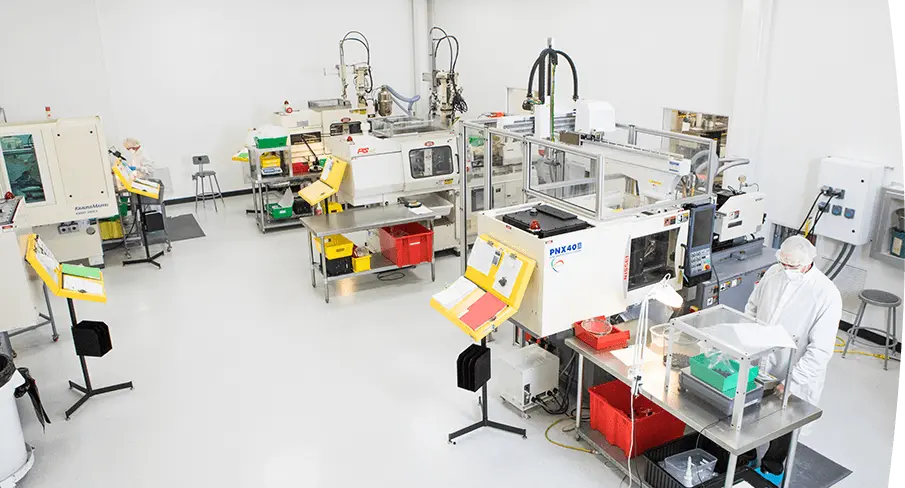
While cleanroom injection molding has many benefits, it also has its own challenges and considerations.
Technical Challenges
- Maintaining sterility throughout the process: Preventing contamination from raw materials and personnel equipment requires attention to detail and protocols to ensure product integrity.
- Preventing particle contamination: To maintain product purity, cleanrooms need modern filtering technologies and careful personnel procedures to reduce particle introduction and creation.
- Ensuring product integrity: The cleanroom molding process must be optimized. Producing parts with specific mechanical properties and dimensions requires process control and quality assurance.
Economic Considerations
- Higher cost: Cleanroom facilities, equipment, and operations are more expensive than traditional injection molding. This cost difference is due to the specialized infrastructure, advanced technology, and regulatory compliance requirements.
- Longer production time and complexity: Cleanroom molding requires more material handling, validation, and paperwork, which can increase production time and complexity.
- Regulatory compliance: Industry standards like FDA and EMA need major investment in documentation, training, and quality systems, raising manufacturing costs.
Regulatory Compliance
- Industry standards: Medical devices, pharma, and other businesses follow product cleanliness and sterility norms. This requires comprehensive product validation, monitoring, and auditing for quality, safety, and efficacy.
- Documentation and traceability: Regulation and quality standards compliance procedures are documented. It requires efficient data administration and a good record-keeping system.
Future Trends and Innovations
Cleanroom injection molding is evolving with technology and industry demands.
Air filtration, material handling, and automation will improve cleanroom capabilities to increase efficiency and reduce contamination risk and capacity.
Cleanroom molding may enter new industries like biotechnology and nanotechnology. For the highest levels of purity the process must be done with the use of isolation to prevent contamination.
Efficiency in using energy in cleanrooms will result in the use of green materials as well as green technology. Automate minimizes contact with people’s hands, thereby minimizing contamination and increasing cleanroom uniformity, quality, and effectiveness.
Conclusion
Plastic components with high purity and no contamination are made using cleanroom injection molding. Manufacturers can achieve product safety and sterility requirements in cleanrooms by adjusting the injection molding process and applying stringent quality control.
With new technologies and applications, cleanroom injection molding has a bright future. Addressing this specific process’s obstacles allows producers to continue producing high-quality, compliant products.
Visit the HITOP Industrial website to use cutting-edge cleanroom injection molding solutions to exceed industry safety and sterility regulations.
Related Articles
- Medical Injection Molding: Precision in Healthcare
- Liquid Silicone Rubber Injection Molding: A Detailed Guide
- Mastering Injection Molding Tolerances: Key Insights
- Reaction Injection Molding: Process, Benefits and Uses
- Injection Molding Defects and Their Solutions
- Aluminum Injection Molding: Cost, Benefits, and Design
- ABS Injection Molding: Key Benefits, Process
- Ultimate Guide to HDPE Injection Molding
- 10 Common Plastic Resins for Injection Molding
- Injection Molding vs. Compression Molding


 English
 Arabic
 German
 Spanish
 French
 Italian
 Javanese
 Korean
 Portuguese
 Russian
 Hindi
 Chinese
