

Liquid silicone rubber (LSR) is revolutionizing manufacturing with its unique properties and wide range of applications.
As a thermosetting polymer, LSR excels in creating durable, high-precision components, making it a top choice in industries like medical devices, automotive, and electronics.

Its versatility and reliability are unmatched in challenging environments.
Ready to see how LSR can transform your product designs?
Keep reading to discover the benefits of liquid silicone rubber injection molding and how it can help you create stronger, more precise, and cost-effective components.
Whether you’re looking for durability or intricate part designs, LSR might be the perfect solution for your next project!
What is Liquid Silicone Rubber (LSR)?

Liquid silicone rubber (LSR) is an inorganic polymer composed of silicon (Si), oxygen (O), carbon (C), and hydrogen (H).
What makes LSR so unique is its siloxane backbone, a chain of alternating silicon and oxygen atoms that provides exceptional flexibility and stability.
During the platinum curing process, catalysts create chemical bonds (crosslinks) between the chains, making LSR strong, flexible, and resistant to various conditions.
This platinum-cured process makes LSR superior to other silicone rubbers, such as those cured with peroxide.
Key Properties of LSR
LSR boasts several key properties that make it ideal for high-performance applications:
- Durability: LSR can withstand wear and tear, making it a reliable material for long-lasting components.
- Extreme Temperature Resistance: Whether it’s freezing cold or scorching hot, LSR maintains its properties across a wide temperature range.
- Chemical Stability: LSR is resistant to many chemicals, including acids and alkalis, which ensures performance in harsh environments.
- Biocompatibility: It’s hypoallergenic and compatible with human tissues, making it ideal for medical devices and products that come into contact with skin.
- Mechanical Strength: LSR offers impressive tear strength, tensile strength, and flexibility, allowing it to handle mechanical stress without degrading.
Advantages of Platinum-Cured LSR
Compared to other curing methods, platinum-cured LSR offers several key advantages:
- Improved Tensile and Tear Strength: Components made from platinum-cured LSR are stronger and more durable.
- Clarity and Consistency: LSR cured with platinum provides excellent clarity, which is especially useful for applications requiring transparency.
- No Residue: Unlike peroxide-cured silicone, platinum-cured LSR leaves no residue, making it ideal for applications where cleanliness and safety are critical.
Material Grades and Options
Standard Silicones

Standard silicones are the go-to option for general applications where flexibility, durability, and temperature resistance are essential.
These materials are versatile, making them ideal for use in everyday products that don’t require specialized properties but still need the reliable performance that LSR provides.
Medical-Grade Silicones

Medical-grade silicones are FDA-approved and specifically designed for applications that come into contact with human skin or bodily fluids.
These silicones are biocompatible, hypoallergenic, and can be sterilized using various methods, making them perfect for medical devices such as catheters, implants, and surgical tools.
Fuel-Resistant and Specialty Silicones

For industries like automotive and industrial, fuel-resistant silicones provide excellent chemical resistance, making them perfect for components that come into contact with fuels, oils, and harsh chemicals.
These specialty silicones ensure that parts perform reliably in challenging environments without degrading or breaking down.
Hardness Range
LSR is available in a wide range of hardness levels, from 5 Shore A to 80 Shore A, offering flexibility for different part applications.
Softer grades are ideal for products that require flexibility, such as seals and gaskets, while harder grades are suited for components that need to withstand higher mechanical stress.
Applications of LSR Injection Molding
#1 Medical and Healthcare

Liquid silicone rubber (LSR) is a top choice in the medical and healthcare industry due to its biocompatibility and resistance to bacteria growth.
It’s widely used in devices such as respirator masks, valves, catheters, and drug delivery systems.
One of its biggest advantages is that it can be easily sterilized using methods like autoclaving and gamma radiation, ensuring safety and hygiene in sensitive medical environments.
Its hypoallergenic properties make it perfect for long-term implants and skin contact products.
#2 Automotive Industry

In the automotive industry, LSR shines due to its extreme temperature resistance and UV stability.
It can handle the intense heat and exposure to elements that automotive parts often face.
LSR is commonly used for wire harness seals, gaskets, vibration dampeners, and sensors, all of which need to maintain their properties in both high and low temperatures.
Its ability to resist fuel and oils makes it a reliable choice for under-the-hood components.
#3 Consumer Products

LSR is also making waves in consumer products, especially in applications where durability, flexibility, and hygiene are essential.
From baby bottle nipples and pacifiers to showerheads, faucets, and kitchenware, LSR is favored for its resistance to wear and tear, as well as its safety in contact with food and skin.
In electronics, it’s used in products like ear tips for headphones and electric toothbrush components, providing soft yet durable solutions that enhance user comfort.
#4 Industrial Applications

In industrial settings, LSR is trusted for its ability to perform in harsh environments.
It is widely used in safety equipment like smoke detectors, carbon monoxide detectors, and gas water heaters, where reliability is non-negotiable.
Thanks to its resistance to chemicals and extreme heat, LSR ensures that these components can operate efficiently even under demanding conditions.
LSR Injection Molding Process

Step 1: Tool Creation
The first step in the LSR injection molding process is creating the mold.
This involves CNC machining to produce a high-temperature mold capable of withstanding the heat and pressure required for LSR molding.
The mold design is critical, especially when working with intricate part geometries, and is typically made from durable materials like steel or aluminum.
Step 2: Injection Process
Once the mold is ready, it’s loaded into an LSR-specific injection molding press.
These machines are precision-geared to control the exact shot size needed for consistent, high-quality parts.
The press injects the liquid silicone into the mold, ensuring that the material fills every cavity, even in designs with thin walls and tight tolerances.
LSR’s low viscosity allows it to flow smoothly, making it perfect for intricate part designs.
Step 3: Curing and Solidification
After injection, the LSR undergoes a curing process where heat and pressure transform it from a liquid into a solid state.
This step ensures that the material retains its desired shape and properties.
Once the LSR cures, it becomes a durable, thermoset material that can no longer be reshaped by heat, ensuring a permanent form.
Step 4: Demolding and Post-Processing
Once the curing is complete, the molded part is removed from the mold.
This is the demolding process, which can be fully automated for high-volume production.
Depending on the application, parts may undergo post-processing steps like cryogenic de-flashing to remove any excess material or trimming to achieve finer tolerances.
Cycle Times and Efficiency
One of the biggest advantages of LSR injection molding is its quick cycle times compared to traditional compression molding.
LSR molds typically have shorter curing times, allowing for faster production.
This leads to reduced labor costs and greater efficiency, especially for large-scale manufacturing projects.
Design Guidelines for LSR Parts
Undercuts
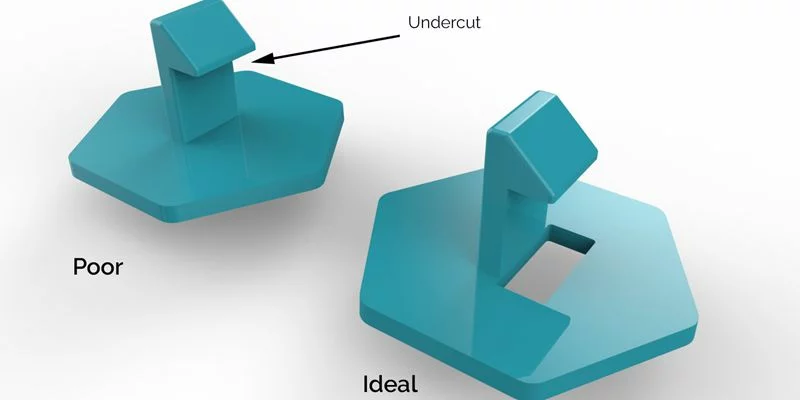
When designing parts for LSR injection molding, it’s important to minimize undercuts.
Undercuts can increase the complexity of the mold, leading to higher tooling costs and potentially slowing down the production process.
By reducing or eliminating undercuts, you simplify the mold design and improve overall efficiency, saving both time and money.
Wall Thickness

Maintaining an even wall thickness is crucial for producing high-quality LSR parts.
Uneven thickness can lead to voids, sink marks, or warping, which compromise the integrity of the part.
A consistent wall thickness ensures smoother material flow, reduces cycle times, and lowers production costs.
Draft Angles

To ensure easy part removal from the mold, it’s essential to incorporate draft angles.
For LSR parts, a minimum of 0.5° draft angle is recommended, but depending on the part’s texture, you might need up to 5°.
This small design consideration helps prevent damage during demolding, ensuring each part maintains its shape and quality.
Ribs and Bosses

Ribs and bosses are key structural elements for LSR parts.
When designing ribs, make sure they are 40-60% the thickness of the outer walls to maintain part strength without adding unnecessary bulk.
Similarly, bosses should be attached to side walls or ribs for additional structural integrity.
This ensures that parts are strong enough to withstand mechanical stress while still being lightweight and cost-effective.
Advantages of LSR Injection Molding

-
Durability and Strength: LSR withstands extreme temperatures, UV light, and chemicals, making it ideal for long-lasting, harsh-environment applications.
-
Precision and Repeatability: Achieve tight tolerances and consistent part quality, even in large-scale, high-volume production runs.
-
Low Contamination Risk: Automated, hands-free production ensures hygienic conditions, perfect for medical devices and food-grade products.
-
Cost-Effective: Faster cycle times and minimal material waste help lower production costs, making LSR molding highly efficient.
-
Sustainability: LSR’s durability reduces the need for frequent replacements, making it a sustainable choice for long-term use.
Challenges and Considerations

While liquid silicone rubber (LSR) injection molding offers many advantages, there are a few challenges to consider.
Tooling Costs: The initial investment in creating high-precision molds for LSR can be significant. However, this cost is often offset by the long-term efficiency gained from faster cycle times and reduced waste in large-scale production runs.
Part Design Complexity: LSR can handle complex part designs with ease, but careful planning is essential to avoid potential issues like flash or distortion during molding. Designers need to ensure that the part geometry, mold design, and material flow are optimized for the best results.
Post-Molding Operations: Some LSR parts, especially those with fine tolerances, may require additional post-molding operations like cryogenic de-flashing or manual trimming.
These processes ensure the final product meets the required precision and surface finish standards.
Quality Control and Standards

ISO Certifications are crucial in maintaining the highest levels of quality in LSR injection molding.
Certifications like ISO 9001 ensure general quality management, while ISO 13485 guarantees compliance with strict standards for medical devices, and IATF 16949 ensures the quality of automotive components.
These certifications provide confidence in the reliability and safety of LSR products.
Dimensional Tolerances are a key advantage of LSR injection molding. The process allows for high precision, with tight tolerances that ensure consistent part quality.
Incorporating design-for-manufacturing (DFM) feedback early in the design phase helps optimize part geometry, reducing errors and ensuring a smoother production process with minimal waste.

Conclusion

Liquid silicone rubber (LSR) injection molding offers incredible versatility, precision, and durability, making it a top choice across various industries.
Its ability to withstand harsh conditions and provide high-quality, consistent parts has revolutionized manufacturing for medical devices, automotive components, and more.
Ready to explore how LSR injection molding can transform your manufacturing process?
Contact us today to discover how this innovative material can help you create reliable, durable, and high-performing products for your next project!


 English
 Arabic
 German
 Spanish
 French
 Italian
 Javanese
 Korean
 Portuguese
 Russian
 Hindi
 Chinese
