


Injection molding is a high-volume manufacturing process for making plastic parts. It’s heating and melting plastic pellets, injecting them into a shaped mold cavity under pressure, and then cooling to form the final product.
This process can produce complex and precise plastic components consistently. The injection molding process involves several steps: preparing the material and mold and using a machine to melt, inject, and cool.
And about ejecting the plastic and, finally, any post-processing on the finished parts.
Preparation
The preparation stage involves selecting the right plastic material, designing and building the mold to match the part. Also involves pre-processing of some materials to ensure molding.
A. Material Selection
The first step is to choose the right plastic material for the part. In injection molding, two types of polymers are used:
- Thermoplastics: Can be melted, shaped, and cooled without changing their chemical structure. Good versatility and recyclability, used for many applications. (Examples: PET, PP, ABS)
- Thermosets: Once heated and formed, thermosets undergo a permanent chemical change and can’t be remelted. Good heat resistance and dimensional stability but less processing flexibility. (Examples: Epoxy, Bakelite)
There are several factors to consider when selecting material:
- Desired properties: Strength, flexibility, heat resistance, chemical resistance, etc.
- Application requirements: Functionality, weight, aesthetics, etc.
- Processing considerations: Melting temperature, flow characteristics, and compatibility with the injection molding process.
B. Mold Design and Building
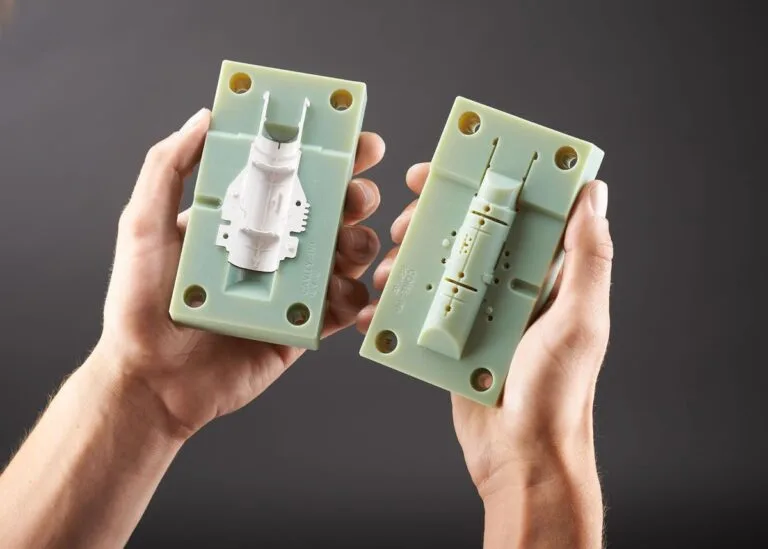
The mold is the heart of the injection molding process as it defines the final shape and features of the plastic part. A well-designed mold ensures efficient production and good parts. Key mold components are:
- Cavity: The hollow space within the mold that replicates the exact shape of the part.
- Runner System: A network of channels that delivers the plastic from the sprue to the cavity.
- Sprue: The main channel where the molten plastic enters the mold from the machine nozzle.
- Other components: Depending on the part complexity, molds may also have ejector pins for part removal and cooling channels for faster solidification. And they also have vents for trapped air to escape.
C. Material Pre-processing
Some polymers, especially hygroscopic materials that absorb moisture easily, need to be dried before injection molding. Moisture can cause bubbles and voids in the final product.
Desiccant dryers are used to remove moisture from plastic pellets using desiccant material. They absorb moisture from the air stream flowing through the dryer chamber.
The Injection Molding Machine
The machine is the workhorse of the process, making plastic pellets into parts. Here’s what it consists of:
- Feeding System: Hopper feeds plastic pellets into the barrel.
- Melting Unit: Barrel and screw work together. The barrel heats the pellets, and the screw melts and mixes them.
- Injection Unit: This powerful system forces the molten plastic into the mold cavity.
- Clamping Unit: This unit applies a strong clamping force to hold the mold halves together during the injection process.
- Cooling System: A network of channels circulates coolant through the mold to control the temperature and solidify the plastic.
- Ejection Unit: Once solidified, the mold opens, and ejector pins are expelled out of the cavity.
Precision is Key
Injection molding relies on precise control of many parameters like temperature, pressure, and cycle time. Sophisticated sensors and monitoring systems are built into the machine to control these parameters within setpoints and ensure good part quality.
The Injection Molding Process

The injection molding process is a precise sequence of events that turns molten plastic into the desired shape. Here’s how it goes:
A. Clamping
The process starts with the clamping unit closing the mold halves under high pressure. This ensures a tight seal to prevent molten plastic from escaping during injection.
B. Injection
- The hopper feeds plastic pellets into the heated barrel.
- As the screw rotates, the heaters melt the pellets, and the screw’s mixing action makes it uniform.
- Once molten, the high pressure from the screw forces the plastic through the sprue and runner system into the mold cavity.
- A “packing and holding stage” is used to account for shrinkage that occurs during cooling. Here, additional molten plastic is injected for a set time to ensure full cavity fill.
C. Cooling and Solidification
This is the critical stage for dimensional accuracy and part strength. Cooling lines in the mold circulate a coolant (water or oil) to remove heat from the molten plastic.
The holding pressure may also be applied during this stage to minimize shrinkage as the plastic solidifies. The total cooling time depends on the part size, wall thickness, and properties.
D. Ejection
Once the plastic has solidified enough, the mold opens. Ejector pins in the mold push the part out of the cavity. Now, the machine can start the cycle again for the next part.
Post-Processing
The injection molding process doesn’t stop when the part ejects from the mold. Post-processing steps refine the molded parts to meet the quality standards:
- Trimming: The excess material from the sprue and runner system is removed from the part, usually with mechanical trimming tools.
- Secondary Operations: Some parts may require additional finishing, like sanding, polishing, or painting. Complex parts may involve assembly with other parts.
- Quality Control: Every molded part is inspected to meet the dimensional specifications and function as intended. This may involve visual inspection, measurement tools, and functional testing.
Advantages and Limitations of Injection Molding
A. Advantages
Injection molding has several benefits that make it a dominant force in high-volume manufacturing. This table highlights some of its key strengths.
| Advantage | Description |
| High Production Rate and Repeatability | Mass production of identical parts fast and on spec. |
| Tight Tolerances and Complex Shapes | Control over part size, so you can make complex shapes. |
| Wide Variety of Materials and Finishes | Many different plastics with different properties (strength, flexibility) and finishes (colors, textures) to meet your design requirements. |
B. Limitations
While injection molding is a versatile process, it does have some drawbacks to consider. This table outlines the limitations to be aware of when choosing a manufacturing method.
| Limitation | Description |
| High Initial Investment Cost | You have to develop the mold for the part and buy the injection molding machine, which is a big upfront cost. |
| Material Waste | The sprue and runner system for the injection process generates plastic waste. Some of this can be reground and reused, but it still adds to the overall material usage. |
| Not Suitable for Low-Volume Production | The high upfront cost makes injection molding not economical for small runs of parts. Other methods might be better for low volume. |
Conclusion
In summary, Injection molding is a great process for making complex plastic parts in high volume. It involves several steps. The steps include preparing materials and mold, using a machine to melt, inject, and cool the plastic, and then eject and finish the parts.
Injection molding offers high production rates, tight tolerances, and many material options. However, the cost of molds and machines is high and not suitable for low-volume production.
For high-quality and cost-effective injection molding solutions, contact HITOP Industrial today. We have years of experience and expertise in helping our clients bring their plastic part designs to life.


 English
 Arabic
 German
 Spanish
 French
 Italian
 Javanese
 Korean
 Portuguese
 Russian
 Hindi
 Chinese
